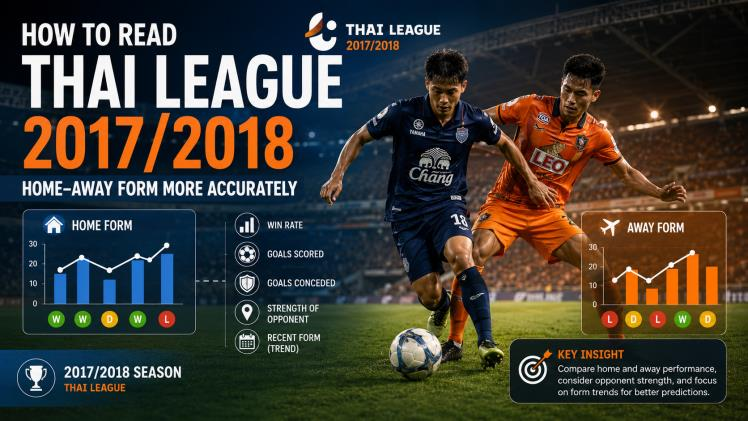

In a league dominated by Buriram United and other giants, the 2017 Thai League season still offered sharp bettors plenty of opportunities away from the spotlight. While the title contenders shaped narratives, it was often the smaller clubs—mid‑table sides, relegation fighters, and regional outfits—that quietly produced the mispriced lines. Finding those teams required reading form, context, and mentality differently from how casual fans judged them.
Why Supporting Smaller Clubs Can Make Sense For Bettors
Backing smaller teams in Thai League 1 is not about hoping for miracles; it is about understanding how markets habitually undervalue outsiders. Historical records show that the league consists of 16 clubs with promotion and relegation, which means every team plays 30 matches and faces a wide range of opponents over the year. Across that schedule, underdogs inevitably win and draw more often than their public reputation suggests, particularly at home or against big clubs dealing with fatigue.
The cause–effect logic runs from perception to price: smaller clubs tend to carry lower fan bases and less media coverage, so their improvements go unnoticed longer. When a modest side stabilises defensively, sharpens set‑pieces, or finds a productive foreign striker, bookmakers may adjust slowly compared with how quickly the team’s actual performance improves. For disciplined bettors, that lag creates value spots where a “small” badge hides a team that is, in reality, a mid‑tier outfit in good shape rather than a whipping boy.
Identifying Small But Competitive Teams In The 2017 Landscape
To talk meaningfully about “small” Thai League teams in 2017, it helps to separate brand power from on‑pitch resilience. The official 2017 Thai League T1 table lists Buriram United as champions, with several well‑known clubs occupying the upper zones, while lesser‑known names clustered around mid‑table and the relegation scrap. These lower‑profile sides often had limited budgets, smaller stadiums, and less history in the top flight, which shaped how both fans and bookmakers framed them before each match.
Yet performance metrics from that same season highlight that not all non‑giant clubs were equally fragile. ESPN’s 2017 Thai League performance stats show that while some teams endured brutal losing runs—one with 27 defeats overall—others maintained roughly balanced records, combining safety from relegation with occasional upsets against bigger names. From a betting point of view, the latter group is where “small but worth supporting” usually lives: teams whose structural level is good enough to threaten favourites under the right conditions, even if they rarely push for titles.
What Made Some Underdogs Attractive: Style, Form, And Mentality
Underdogs become attractive when their playing style narrows the gap to stronger opponents in repeatable ways. In 2017 Thai League 1, certain smaller clubs leaned into compact defensive shapes, aggressive pressing in spells, and targeted set‑piece routines that allowed them to steal points without out‑playing elite sides over 90 minutes. These traits did not always translate into high goal totals, but they kept matches tight and made handicaps especially interesting when bookmakers assumed the big club would win comfortably.
Mentality also mattered. Small teams that regularly responded well after going behind, or that rarely collapsed into heavy defeats, signalled a competitive culture rather than passive survival. ESPN’s data on current losing and unbeaten runs, even in short bursts, revealed how some underdog squads could string together steady spells that contrasted sharply with the worst performers, who recorded the longest losing streaks in the division. For bettors, that resilience reduced the risk of late‑game implosions that ruin plus‑handicap tickets, making certain small clubs quietly reliable when spotted at generous lines.
Using A Simple Profile Table To Sort “Backable” Small Teams
Because different small clubs embody different forms of competitiveness, summarising their traits helps sharpen pre‑match decisions. Instead of focusing on specific names only, it is useful to think in profiles that reflect patterns observed in the 2017 table and performance stats—mid‑table grinders, home‑strong outfits, chaotic relegation candidates, and truly weak sides.
| Small‑team profile | Core 2017‑style trait | Betting implication from a value angle |
| Mid‑table stabiliser | Balanced results, few heavy defeats | Consider +handicap and double‑chance vs bigger clubs |
| Home‑fortress underdog | Strong home record, travel‑weakened away form | Target home matches; ignore or fade them away |
| Relegation fighter with spirit | Frequent draws, late equalisers | Look at +handicap and under/BTTS markets |
| Collapsing struggler | Long losing streaks, heavy scorelines | Mostly oppose or avoid, even at big prices |
This table matters because it turns “small” into a set of tactical and psychological features rather than a single label. A mid‑table stabiliser can be a solid ally in +0.5 or +1 lines against giants, precisely because they very rarely lose by large margins. A home‑fortress underdog may be too risky on the road but highly playable in front of their own crowd. Meanwhile, collapsing strugglers with records akin to the teams registering the longest losing runs in ESPN’s 2017 data are usually poor candidates to back at all, since their underlying problems overshadow any theoretical price value.
How UFABET Can Help Operationalise Small‑Team Edges
Once a bettor has identified which smaller Thai League sides fall into the more competitive profiles, the next challenge is converting those views into specific wagers without losing discipline. In situations where, for example, a mid‑table stabiliser is hosting a fatigued giant, the question becomes whether to use handicaps, double‑chance, goal lines, or a mix of these ideas. Under these conditions, many punters prefer to work within a structured online betting site such as ufabet download, where Thai League markets are laid out in a way that makes it easier to compare alternative expressions of the same edge—+0.75 instead of +1, team‑total overs instead of full‑time result—and then scale stakes so that one attractive underdog scenario does not unbalance the overall risk profile.
Where casino online Dynamics Undermine Thoughtful Underdog Betting
Smart underdog betting thrives on patience and selective engagement, yet that temperament can erode when wagers sit inside faster, more stimulus‑driven environments. A bettor who has carefully profiled small Thai League teams based on 2017 form can still fall into impulsive patterns if the wider context encourages constant action. That tension often surfaces when someone moves from focused league analysis into a broader casino online setting, where instant‑resolution games, side promotions, and non‑football bets tempt them to chase the same “upset” rush without the supporting research. The effect is that the very edge created by understanding resilient small clubs is diluted by unrelated, high‑variance decisions taken purely for short‑term excitement.
Failure Cases: When Small Teams Look Tempting But Are Actually Traps
Not every small club showing a few bright results becomes a sound betting ally. In 2017, teams with extremely long losing records, identified by ESPN’s statistics as having up to 27 defeats or extended current losing streaks, highlighted how dangerous it is to confuse being “due a win” with being undervalued. These sides sometimes produced isolated surprise results, but their underlying issues—weak squads, tactical confusion, and poor morale—remained unchanged, causing more sustained damage to anyone who kept backing them at large odds.
Another failure case appears when a small team strings together a short unbeaten run driven by penalties, late set‑piece goals, or opponents’ red cards. Without structural improvements in ball progression, chance creation, or defending, those points can flatter them in the table and attract emotional support from fans, but they fail to justify improved prices from a value perspective. Over time, bettors who mistake these noise‑driven streaks for genuine transformation find that the market caught up faster than the team’s true level, leaving only thin or negative expectation when they continue to back the badge.
Educational Perspective: What 2017 Teaches About Backing Small Thai League Clubs
Treating the 2017 Thai League season as a case study, the key educational takeaway is that “small but worth backing” is a moving target defined by structure and context, not romance. The league’s 16‑team format, combined with promotion and relegation pressure, created a spectrum from Buriram‑level dominance down to chronic losers, with several modest clubs quietly inhabiting the space where competitive performances outpaced public esteem. Those are the teams that rewarded patient bettors who matched handicaps and double‑chance bets to their strengths instead of chasing headline upsets every week.
From an applied standpoint, the lesson extends beyond that single season. Whenever a new Thai League campaign begins, the 2017 patterns remind bettors to ask three questions about smaller sides: are they structurally stable or drifting toward collapse, do their home and away records tell different stories, and is the market still pricing them on last year’s reputation rather than current performance? Re‑using those questions across seasons helps rebuild a watchlist of underdogs worth supporting, ensuring that enthusiasm for small clubs is grounded in sustained edges rather than in story‑driven hope.
Summary
Looking at 2017/2018 through a bettor’s lens shows that the most interesting Thai League opportunities often sat with smaller clubs who defended well, competed hard at home, and avoided heavy defeats, even if they rarely troubled the title race. These sides fit into profiles—mid‑table stabilisers, home‑fortress underdogs, and spirited relegation fighters—that lent themselves to plus‑handicap and double‑chance strategies rather than outright hero bets on league outsiders.